 Become a partner
How to choose flooring for commercial spaces
Choosing flooring for a commercial space involves more than comparing designs and prices per square metre. An entrance, office and kitchen face different demands, even within the same building. A sound decision considers foot traffic, furniture and equipment, cleaning routines and the time available for repairs.
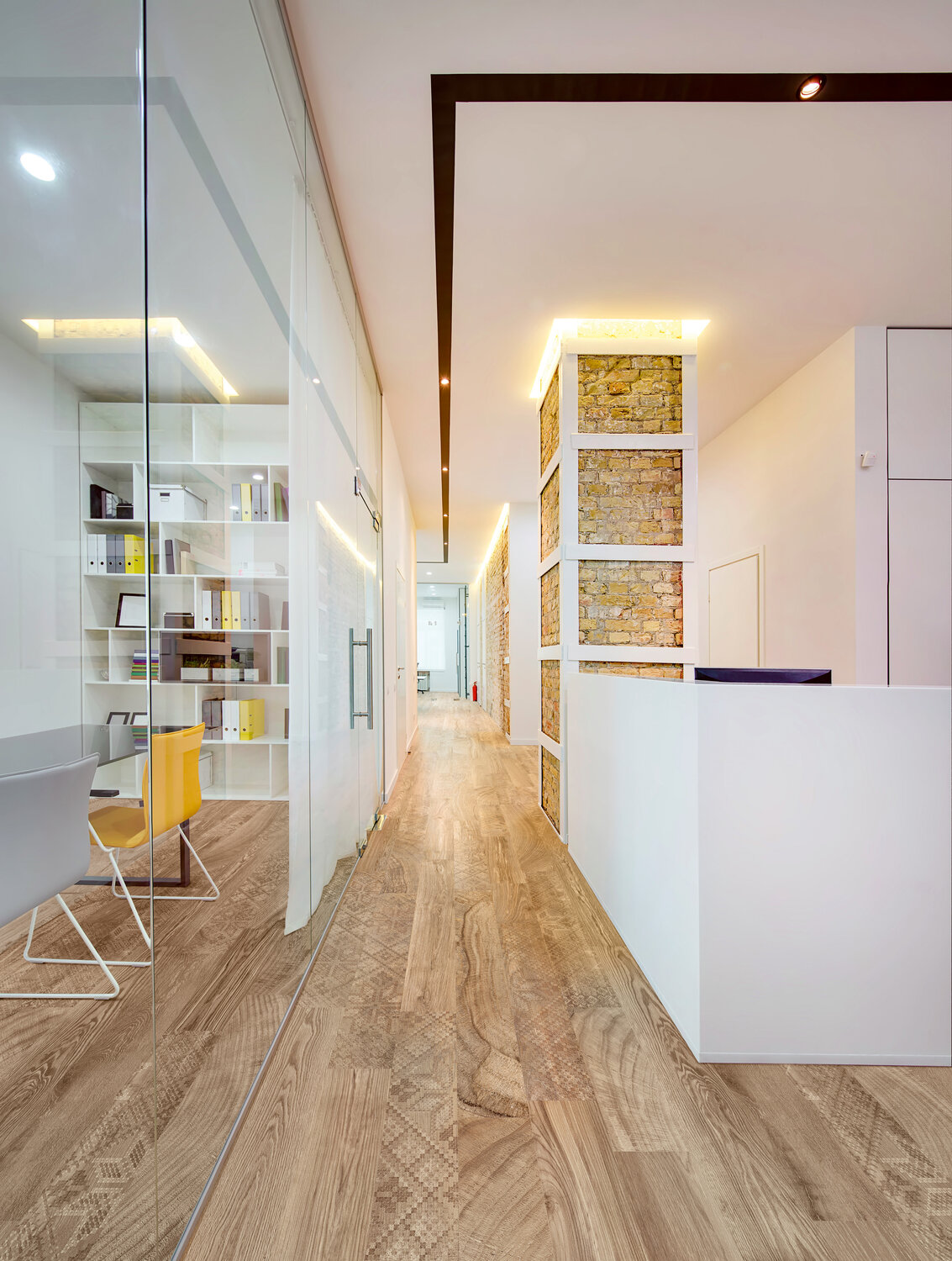
1. Divide the building into use zones
Before requesting a quotation, mark entrances, main circulation routes, workstations, waiting areas and wet areas on the plan. For each zone, ask who will use it, what will be moved across it and how it will be cleaned.
| Zone | Main demands | What to check |
|---|---|---|
| Entrance and reception | Grit, rainwater and heavy foot traffic | Use class, entrance matting and slip testing relevant to actual conditions |
| Open-plan office | Castor chairs, desk legs and footsteps | Castor-chair testing, residual indentation and acoustic performance |
| Shop and showroom | Customer traffic, shelving and changing displays | Use class, concentrated loads and options for local repairs |
| Breakout and meeting room | Comfort, noise and interior design | Underfoot feel, maintenance and acoustics |
| Kitchen and wet area | Water, grease and cleaning chemicals | Manufacturer approval for the area, seams, slip performance and chemical resistance |
2. Do not confuse use class with thickness
EN ISO 10874 classifies resilient, textile and laminate floor coverings by intended use and traffic intensity. For commercial applications, class 31 indicates moderate use, 32 general use, 33 heavy use and 34 very heavy use. Suitability for a particular flooring type must be checked against its product standard and manufacturer documentation.
“It is 12 mm thick, so it must be more durable” is not a reliable selection rule. Total thickness, the protective surface and the core serve different purposes. For laminate, the AC rating describes surface abrasion resistance; it does not replace the use class, water-resistance information or castor-chair test. Comparing the thickness of different materials directly can also be misleading.
3. Find these five items in the technical data sheet
- Residual indentation: this measures deformation remaining after a load is removed. Compare results obtained using the same test method, and specify the size and load of furniture feet separately.
- Castor chairs and rolling loads: suitability for an office chair does not automatically mean suitability for a loaded trolley.
- Acoustics: reducing impact sound transmitted through a floor is different from reducing reverberation within a room. Ask for results for the tested flooring and underlay combination.
- Slip performance: results depend on the test method and on water or other contamination. An R rating alone does not establish suitability for every wet area.
- Fire performance and emissions: these are separate requirements from wear classification. Identify the documents required for the project in advance.
4. Where can you start comparing products at FloorEx?
The catalogue lists Classen Impression Alicante, 56580V4, Kaindl AQUApro Supreme, K5756, Clix Floor Charm, CXC153-2 and Quick-Step Impressive Ultra, IMU1847 as use class 33. These are starting points for comparing laminate products. A catalogue entry is not automatic approval for your project: confirm the current technical data sheet and commercial warranty for the exact product code.
For zones requiring frequent damp cleaning and heavy traffic, compare sheet vinyl; for modular repairs and design choice, consider LVT and SPC flooring; and where softness and sound are priorities, consider carpet tiles separately. A category appearing on the website does not mean every model is in stock. Confirm the model, quantity and lead time when enquiring.
5. Budget for more than the material
Use a simple comparison: material + subfloor preparation + adhesive or underlay + installation + profiles + maintenance + potential repairs and downtime. Compare the same area over the same period. A less expensive material may need more costly subfloor preparation.
For example, a material-price difference of AZN 5/m² over 200 m² amounts to AZN 1,000. This is an illustrative calculation, not a quotation. If the alternative requires an additional AZN 1,500 in preparation and site arrangements, the apparent material saving disappears. Base maintenance costs on a cleaning plan rather than a guess.
A short enquiry to send your supplier
“Building use: __. Zone and area: __. Traffic and operating hours: __. Furniture, chair and trolley loads: __. Exposure to water and chemicals: __. Existing subfloor: __. Acoustic and fire requirements: __. Completion date: __. Please provide the exact product code, technical data sheet, installation requirements, commercial warranty and a quotation covering all work.”
Use this information to contact FloorEx. It turns a design preference into a proposal you can compare on technical merit and total cost.